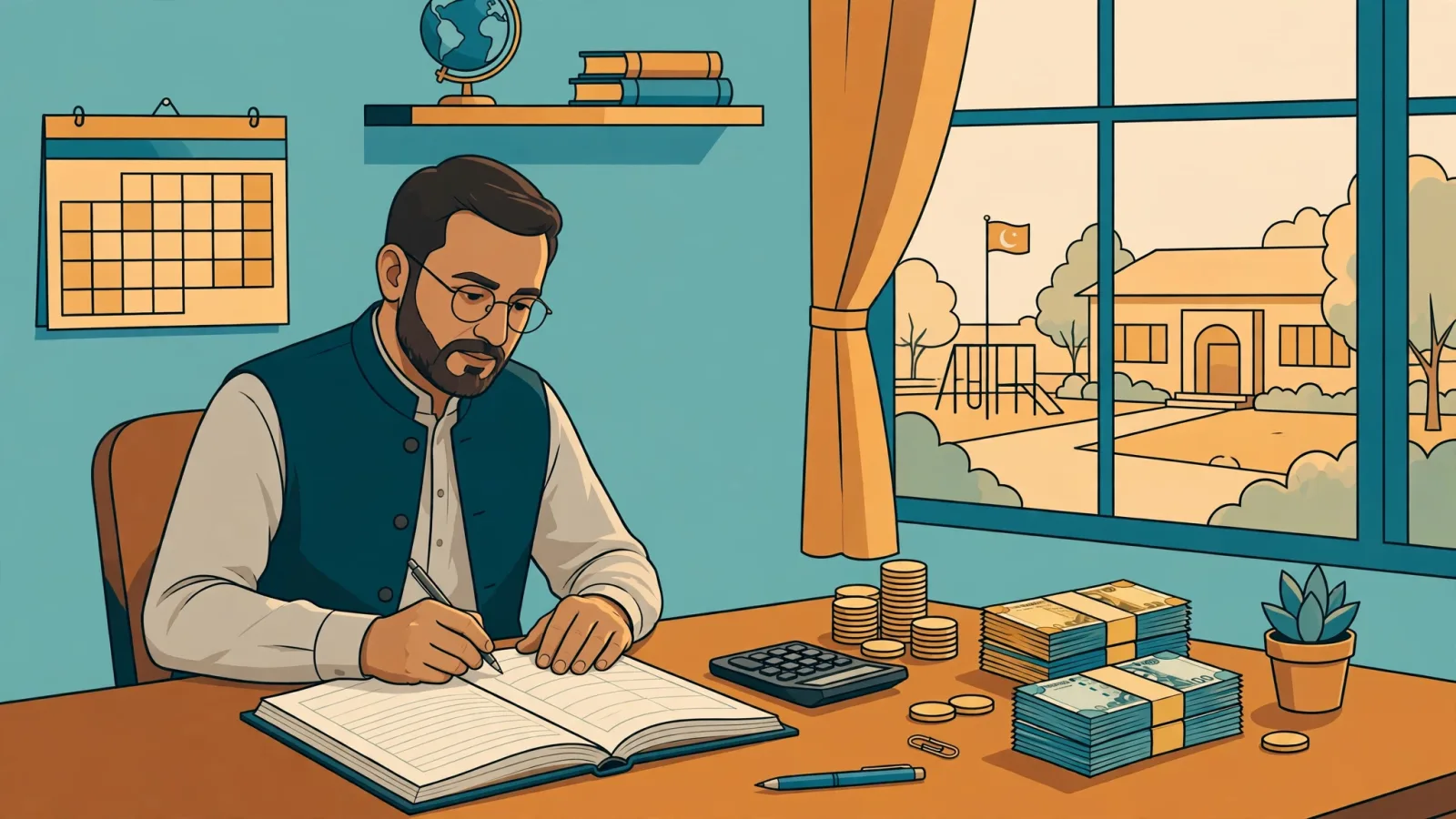
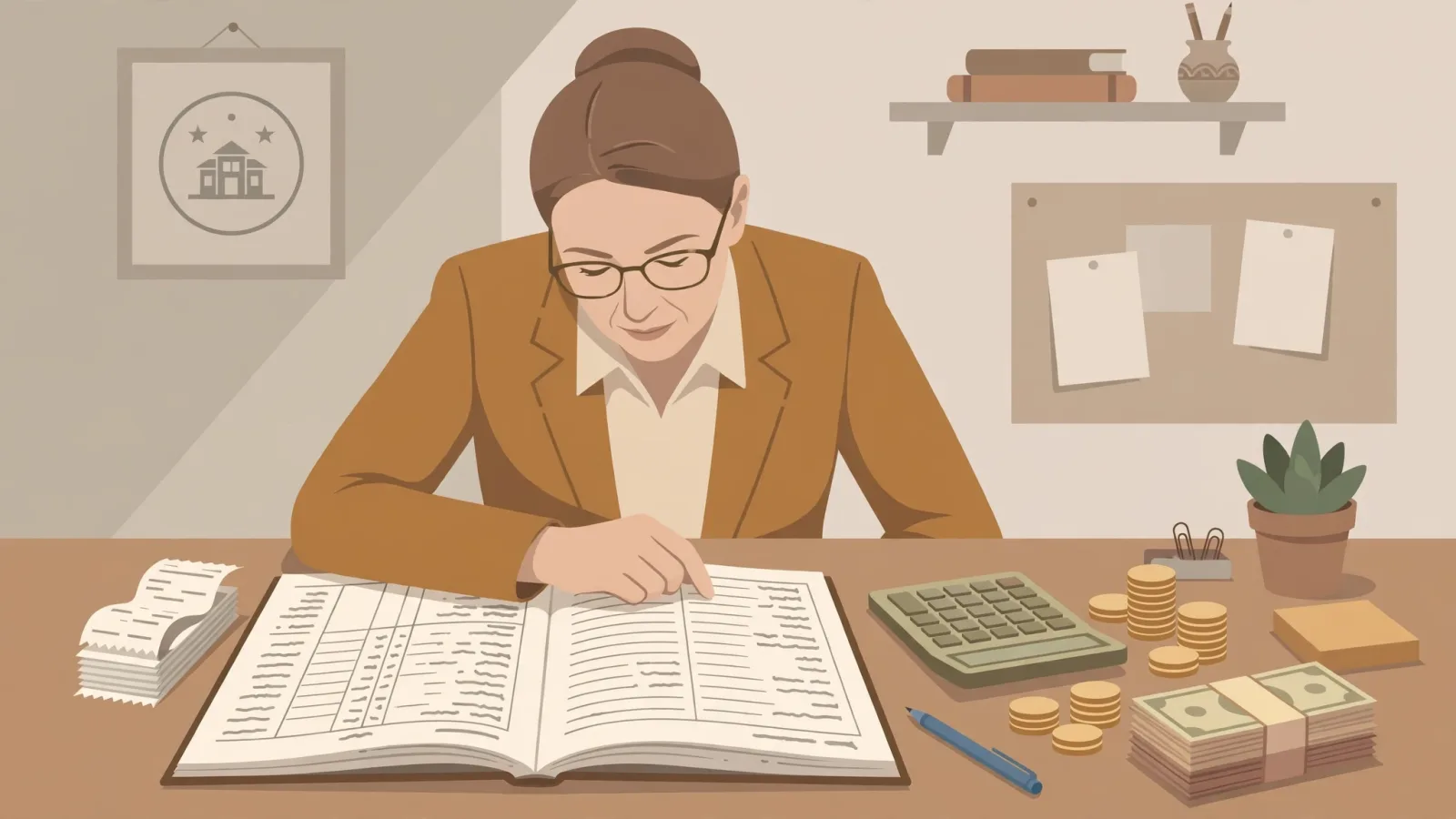
Short answer: School expense management is a weekly habit, not an accounting degree. Record every rupee the day it leaves the school, sort spending into a few fixed categories, and review the totals once a month. Schools that do this stop the slow cash leakage that eats their margins.
Ask a school owner how much their school spent last month and you will usually get a pause, then a rough guess. Not because the owner is careless, but because the money left in a hundred small pieces: a plumber paid in cash, stationery bought on the way to school, a printer repair settled from the fee drawer, diesel for the van, tea for a staff meeting. None of these feels big on its own. Added up, they are often the difference between a school that survives the session and one that quietly runs short.
This guide gives you a simple expense tracking system that works for a small private school in Pakistan — no accountant required, no complicated software to learn first. You can start it with a notebook this week and move it into a proper system when you are ready.
Why school expense management fails in small schools
Most schools do not have an expense problem caused by one big wasteful purchase. The money leaks in smaller, more ordinary ways:
- Cash spending with no record. Someone pays for something out of pocket or from the fee drawer, and the receipt is lost or never written down.
- One person handling everything. The owner collects fees, pays the bills, and keeps the records in their head. When they are busy or away, nothing is recorded.
- No categories. Everything goes into one notebook as "expenses", so at month end nobody can say whether salaries, repairs, or supplies ate the budget.
- Reviewing too late. Expenses are only looked at when money runs short — by which time the pattern that caused the shortage is months old.
The fix is not more discipline. It is a routine so simple that it survives busy weeks.
Step 1: Fix your expense categories — and keep them few
School expense management starts with sorting spending into a small set of categories. Too many categories and nobody fills them in; too few and the totals tell you nothing. For most small schools, these eight cover everything:
- Salaries and benefits — teaching and non-teaching staff pay, EOBI or social security contributions where applicable, and any staff allowances.
- Rent and utilities — building rent, electricity, gas, water, and internet bills.
- Teaching supplies — textbooks, notebooks, stationery, exam paper and printing, classroom materials.
- Repairs and maintenance — building repairs, furniture, fans, plumbing, electrical work, and whitewash.
- Transport — van fuel, driver salary (if not under salaries), vehicle maintenance, and route costs.
- Marketing and admissions — banners, pamphlets, admission campaigns, and open-day costs.
- Office and admin — phone bills, postage, office supplies, and registration or legal fees.
- Miscellaneous — everything else, kept deliberately small. If this category grows past 10% of monthly spending, it is a sign your categories need adjusting, not that spending is fine.
Write these categories on the first page of your expense register. Every expense from now on gets one of them — no exceptions, no "general" entries.
Step 2: Record every expense the same day it happens
The single most important rule of school expense management is timing: record the expense on the day it happens, not at month end. Memory is the worst accounting system ever invented. A Rs 2,500 plumbing bill forgotten on Monday becomes an unexplained gap on Friday.
For each expense, write down five things:
- Date
- Amount
- Category (from your list above)
- What it was for, in plain words ("repaired Class 5 ceiling fan", not "misc")
- Who paid and who received it
Keep the receipt or bill with the entry. A plastic folder per month, with receipts in date order, is enough. If the payment was in cash and there is no printed receipt, write a small handwritten voucher and have the receiver sign it. This one habit alone — a same-day record plus a slip of paper — closes most of the leakage in a small school.
Set a rule for who can spend: only two or three named people may authorise spending, and nobody approves their own expense. Even in a family-run school, this separation matters. It is not about mistrust; it is about having a second pair of eyes on every rupee.
Step 3: Separate school money from personal money
This is where many small school owners lose track without realising it. The fee drawer pays for a family grocery run; a personal account covers a school repair; by month end, nobody can say what the school actually spent.
Keep one bank account (or at least one clearly marked cash box) for the school only. All fee income goes in; all school expenses come out. When the owner needs money from the school, record it as an owner withdrawal, not as an expense. When the owner puts personal money into the school, record it as an owner contribution. This separation does two things: it makes the monthly totals honest, and it protects the owner when questions come up later — from a partner, a tax consultant, or a future buyer of the school.
Step 4: Run a 30-minute monthly expense review
Once a month, sit down with the register and answer four questions:
- How much did we spend in each category? Add up the month's entries by category and compare with last month. A jump in any category is a question, not an accusation — find the reason before it repeats.
- What surprised us? Every month has one or two expenses nobody expected. Write them down; if the same surprise appears twice, it is a recurring cost that needs a budget line.
- Did income cover spending? Compare total monthly expenses with total fee collection for the month. If spending exceeded collection, find out why now — not when the salary date arrives. For help getting fees in on time, see our guide to reducing fee defaulters.
- What can we cut or postpone next month? Pick one item. Expense control works one decision at a time, not through a grand cost-cutting drive.
Do this review on a fixed date — the 2nd of every month, for example, right after salaries are settled. A review that happens "when there is time" never happens. If you run payroll from the same records, the review pairs naturally with checking that teacher pay went out on time and in full.
Step 5: Control the three biggest leakage points
In small Pakistani schools, three areas leak more money than everything else combined. Watch them closely:
Petty cash without limits
Petty cash is meant for small, urgent purchases — not as a second budget. Set a weekly petty cash limit (for example, Rs 5,000) and a rule that anything above it needs the owner's approval in advance. Refill petty cash only against receipts for what was spent, never by topping it up blindly. When the receipts do not add up to the refill, you have found your leak.
Repairs paid in cash with no quote
Repairs are the easiest place for inflated bills, because the work is done before the price is discussed. For any repair above a threshold you set (say Rs 10,000), get the quote in writing before the work starts, and get a second quote for anything above Rs 25,000. Keep both quotes with the payment record. This single rule has saved many school owners more than any software ever will.
Supplies bought in a hurry
Emergency purchases cost more — the nearby shop, the urgent delivery, the premium brand because it was the only one in stock. Keep a small stock of the things you always need (paper, markers, registers, cleaning supplies) and buy them monthly in bulk from one supplier, at an agreed price. The monthly shopping list takes an hour; the savings repeat every month.
Step 6: Build a simple annual expense budget
Once you have three months of categorised records, you can build a realistic budget — and that budget is what stops the school running out of money mid-term. Add up each category's average monthly spend, multiply by twelve, and add known annual costs: summer repairs, annual function, textbook season, exam printing. That total is your school's real annual expense figure, and it is almost always higher than the number in the owner's head.
Compare it with expected annual fee income. If expenses exceed income, you have found the problem early, while there is still time to act — adjust fees for the next session, cut a category, or chase overdue fees. Finding this gap in November is a management problem; finding it in February, when salaries are due, is a crisis. (A full budget method is coming in our next post on school budget planning.)
Your first-month expense tracking checklist
Copy this and pin it in the office:
- Expense categories written on page one of the register
- Every expense recorded the same day, with date, amount, category, purpose, and payer
- Receipt or signed voucher filed for every payment
- School money kept separate from personal money
- Petty cash refilled only against receipts
- Quotes in writing before repairs above Rs 10,000
- Monthly review on the 2nd: category totals, surprises, income vs spending, one cut for next month
After one month of this routine, you will know something most school owners never learn: exactly where the money went. That knowledge is what turns a school from a business that feels profitable into one that provably is.
How Classonix helps with the record-keeping
A notebook works, and it is where every school should start. But notebooks get lost, handwriting gets argued over, and totals have to be added by hand. Classonix keeps the same routine in one place: income and expenses are recorded with categories, a transaction log shows every entry, and profit-and-loss reports add the categories up for you — so the monthly review takes minutes instead of an evening with a calculator. Fee records and WhatsApp reminders with sent, delivered, and read tracking help the income side arrive on time, which is what makes the expense side manageable in the first place. For a small school, the free plan covers up to 100 students, so trying the system costs nothing while you judge whether it fits your routines.
Frequently asked questions
How much should a small school spend on non-salary expenses?
There is no single right percentage, because rents and transport costs vary hugely by city and school size. The useful check is your own trend: if non-salary spending creeps up month after month without more students or better facilities to show for it, something is leaking. Compare each category with its own three-month average rather than with another school's numbers.
Do I need an accountant for school expense management?
Not at this stage. A simple categorised register, kept daily and reviewed monthly, is enough for a school with a few hundred students. Bring in an accountant once a year for tax filing and annual accounts — and hand them a clean register instead of a bag of receipts, which also keeps their fee down.
What if my staff resist recording every expense?
Make the record part of the payment, not an extra chore: no entry, no reimbursement. Reimburse out-of-pocket spending only against a same-day entry with a receipt. Within two weeks, recording becomes automatic, because the rule is simple and it applies to everyone including the owner.
How do I handle expenses paid before I started tracking?
Do not try to reconstruct the past — it wastes time and the numbers will be wrong anyway. Start from today, record everything going forward, and after three months you will have a reliable picture. Note the starting cash balance on day one so the register reconciles from there.
Can expense tracking really stop cash leakage?
Yes, but not by magic. Tracking does not stop spending; it makes spending visible. Most leakage in small schools is not theft — it is forgotten purchases, duplicate buying, and small overpayments that nobody noticed. Visibility is what stops them, because people spend differently when they know the entry will be reviewed.