Chasing school fees is the part of running a school nobody enjoys. The classrooms are full, the teachers are waiting to be paid, and somewhere in the office there is a list of parents who were "definitely paying next week."
For a growing number of private schools in Pakistan, WhatsApp fee reminders for schools have replaced the old routine: paper slips that never make it home, SMS messages nobody reads, and phone calls the front desk dreads making. Parents here live on WhatsApp. A short reminder sent there gets read — usually the same day — while the same message sent any other way quietly disappears.
Doing it well is simpler than most school owners expect. The short answer: send short, polite, personalized reminders at three or four well-chosen moments — a few days before the due date, on the due date, and once or twice after — and automate the process so nobody in your office has to track who paid and who didn't. This guide covers each part: why WhatsApp works, exactly what to write, when to send, and how to automate reminders for hundreds of parents without hiring extra staff.
Why WhatsApp fee reminders work for schools
Every older method of reminding parents has a failure point. Paper slips get crushed at the bottom of school bags. SMS inboxes are buried under bank alerts and telecom spam. Phone calls take staff time, put parents on the spot, and often end with a promise that evaporates by evening.
WhatsApp avoids all three problems at once. The message lands on the screen parents actually check throughout the day, it costs next to nothing to send, and — unlike a phone call — it doesn't demand an answer on the spot. A parent can read it during a work break, forward it to their spouse, and reply with a payment screenshot in the evening. That two-way thread is the real advantage: a paper slip is a dead end, but a WhatsApp message is a conversation.
There is one condition. WhatsApp works because it feels personal. The moment reminders start feeling like spam — too many messages, a rude tone, someone else's child named in the text — parents tune them out just like they tuned out SMS. The channel gets your message read. What you write decides whether you get paid.
What to write: the anatomy of a fee reminder parents act on
The best fee reminders are short. A parent should understand the whole message in five seconds: who it is from, whose fee it is, how much is due, by when, and how to pay. Everything else is noise.
The five parts every reminder needs
- Your school's name, first. Parents save school numbers under all kinds of names. Start with the school name so the message is never a mystery.
- The student's name and class. A message addressed to "dear parent" is easy to ignore. One that names the child is not.
- The exact amount and what it is for. "Rs 8,500 — October monthly fee" beats "your pending dues" every time. If there are several heads (monthly fee, annual charges, paper fund), list them on separate lines.
- The due date. "Due by the 10th" creates urgency; "at your earliest" creates nothing.
- How to pay. This is the part most schools forget. Include the bank account number, Easypaisa/JazzCash details, or the office timings for cash payment. A parent who is willing to pay but doesn't know where to send the money will put it off until tomorrow.
Put together, a good reminder looks like this:
"Assalam-o-Alaikum, this is [School Name]. A friendly reminder that the October fee for [Student Name] (Class [5]) of Rs [8,500] is due by [10 October]. You can pay via bank transfer to [account number] or at the school office between 8am and 2pm. JazakAllah."
Five seconds to read, everything answered, polite from start to finish.
Which language should the reminder be in?
Write the way your parents talk, not the way your letterhead looks. In many Pakistani schools, reminders in Roman Urdu get the fastest responses, because every parent can read them on a phone screen — including those who struggle with English. If your parent body is comfortable with English, English works just as well. The only wrong choice is formal, stiff wording that sounds like a legal notice. It puts parents on the defensive before they have finished reading.
One more rule on tone: stay polite and firm, never threatening. A friendly reminder followed by a firm second notice collects more fees than a single aggressive message. Threatening messages don't scare parents into paying — they get screenshotted into parent WhatsApp groups, and then you are managing a reputation problem instead of a fee problem.
When to send: timing and frequency that get results
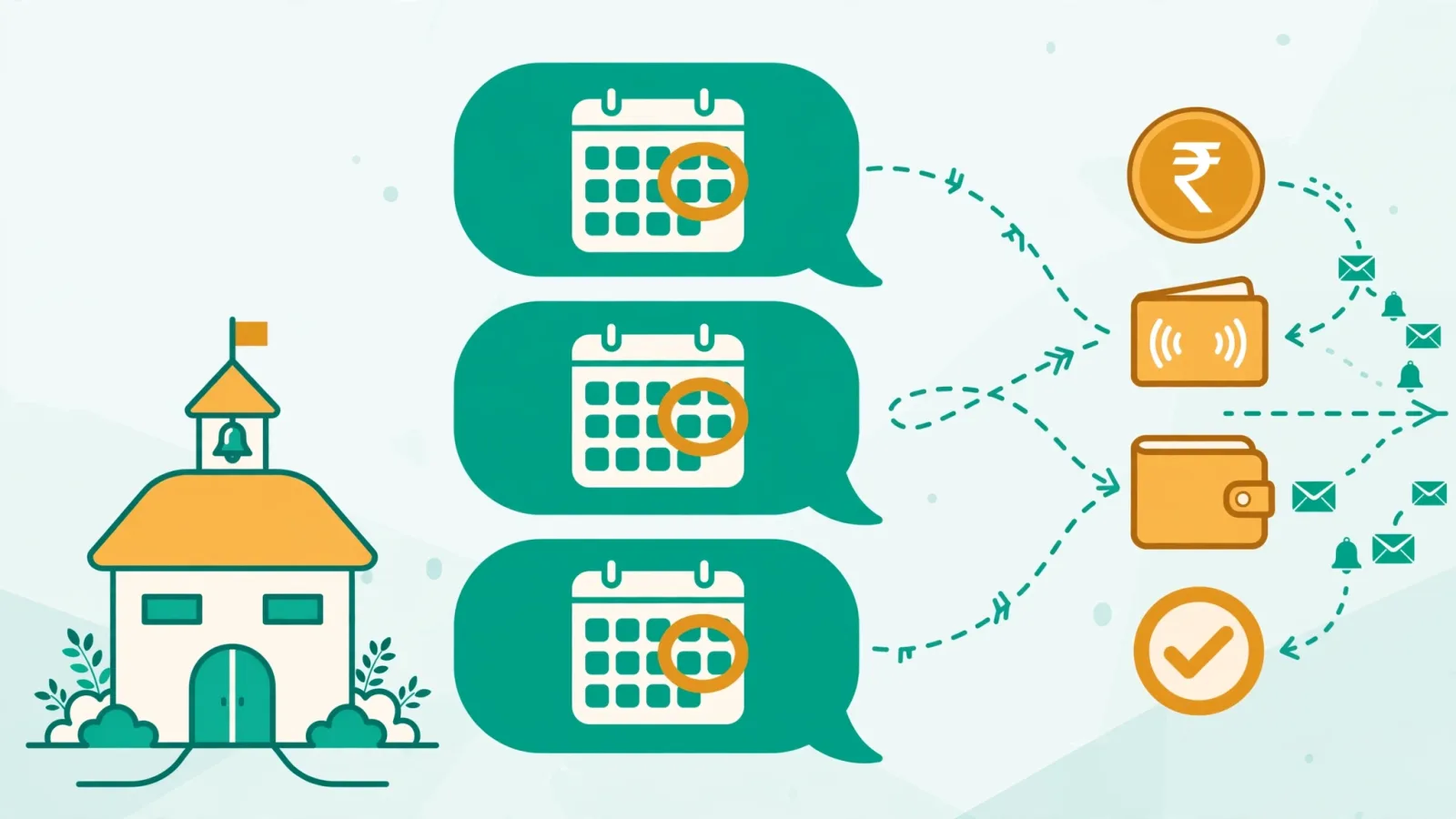
Timing matters almost as much as wording. Send too early and the message is forgotten; send too often and parents start muting you. A schedule that works for most schools:
- 3 days before the due date — a polite heads-up. "Just a reminder that fees are due on the 10th." Most on-time payers only needed the nudge.
- On the due date — a short follow-up for those who forgot. Keep it to two lines.
- 3–5 days after the due date — firmer. Mention the amount again and repeat the payment options.
- One final notice before any late fee applies — if your school charges late fees, this is where you say so plainly. The reminder should arrive early enough that the parent still has time to avoid the charge.
That is three to four messages per fee cycle at most. Anything beyond that trains parents to ignore you. Send during sensible hours — late morning or early evening, not late at night — and keep a record of which reminders went to whom, so two staff members never chase the same parent twice.
Automating WhatsApp fee reminders
Sending reminders by hand works when you have forty students. At three hundred, it means someone in the office spending days every month copying names and numbers into WhatsApp — and still missing people. This is the step where automation pays for itself.
A proper setup should do four things: pull the list of students with pending or partially paid fees automatically, personalize every message with the student's name, class, amount, and due date, send the messages in manageable batches, and show you what happened to each one — sent, delivered, read, or failed. It should also track how many messages you have used against your monthly limit, because WhatsApp messaging is metered.
Classonix's WhatsApp Reminders module is built exactly for this workflow. It lists every student with pending or partial fees so you can select who to remind, uses an editable template with placeholders for the school name, student name, class, fee amount, and due date, and sends in batches of up to 50 parents at a time. Every message is tracked through QUEUED, SENT, DELIVERED, READ, and FAILED states, and the dashboard shows your sent, limit, and remaining quota for the month — 50 messages on the Free plan, 600 on Growth, 1,500 on Professional, and 2,500 on Elite. If a message can't be sent through the API, the composed text is shown so it can be sent manually instead of being lost, and schools can connect their own WhatsApp Business API credentials or use the shared Classonix ones. Phone numbers are normalized to international format automatically, so reminders don't fail on badly saved contacts.
Reminders are only one part of the picture — they work best connected to automatic bill generation, late-fee rules with grace days, and installment plans. For the full setup, read our guide on how to automate school fee collection.
Mistakes that make parents ignore your reminders
- Sending to the wrong number. Numbers change, and sometimes the father's number is on file while the mother handles fees. Update parent contact records every term, or your reminders are going nowhere.
- Generic messages. "Dear parent, your dues are pending" names nobody and states no amount. Personalize, or don't bother.
- No payment instructions. Telling a parent to pay without saying where is like giving directions without an address.
- Threatening language. It backfires, as discussed above.
- No follow-up system. One reminder and then silence teaches parents that reminders don't matter. The schedule above only works if someone actually follows it — which is exactly why automation beats good intentions.
Frequently asked questions
How many fee reminders should a school send each month?
Three to four per fee cycle is the sweet spot: one before the due date, one on the due date, and one or two after. More than that and parents start ignoring your messages; fewer and the forgetful ones slip through.
What should a WhatsApp fee reminder message say?
Five things: your school's name, the student's name and class, the exact amount and fee head, the due date, and how to pay. Keep it to a few lines, polite in tone, and personalized — never a generic "dear parent, dues pending."
Can a school send WhatsApp fee reminders to all parents at once?
Yes, with the right tooling. Sending hundreds of identical messages by hand from a personal number is slow, and the number can get flagged. Batch-sending tools — Classonix sends in batches of up to 50 — handle the volume properly, personalize each message, and track delivery so you know who actually received the reminder.
How can software help reduce fee defaulters?
Reminders are one piece of the system. The full setup includes automatic billing, late-fee rules, installment plans, and payment tracking. Our guide on 7 proven strategies to reduce fee defaulters covers the complete playbook.
Fee reminders will never be anyone's favorite job, but they don't have to be a monthly crisis either. Write short, personal, polite messages, send them at the right moments, and automate the repetitive part — then the awkward phone calls become the exception instead of the routine. If you'd like to see how reminders fit into a complete school management system, Classonix includes WhatsApp reminders on its free plan so you can start right away.