
Automate School Fee Collection
Generate fees for a whole class, record payments, track PENDING to PAID statuses and follow up with WhatsApp reminders — all in one workflow.
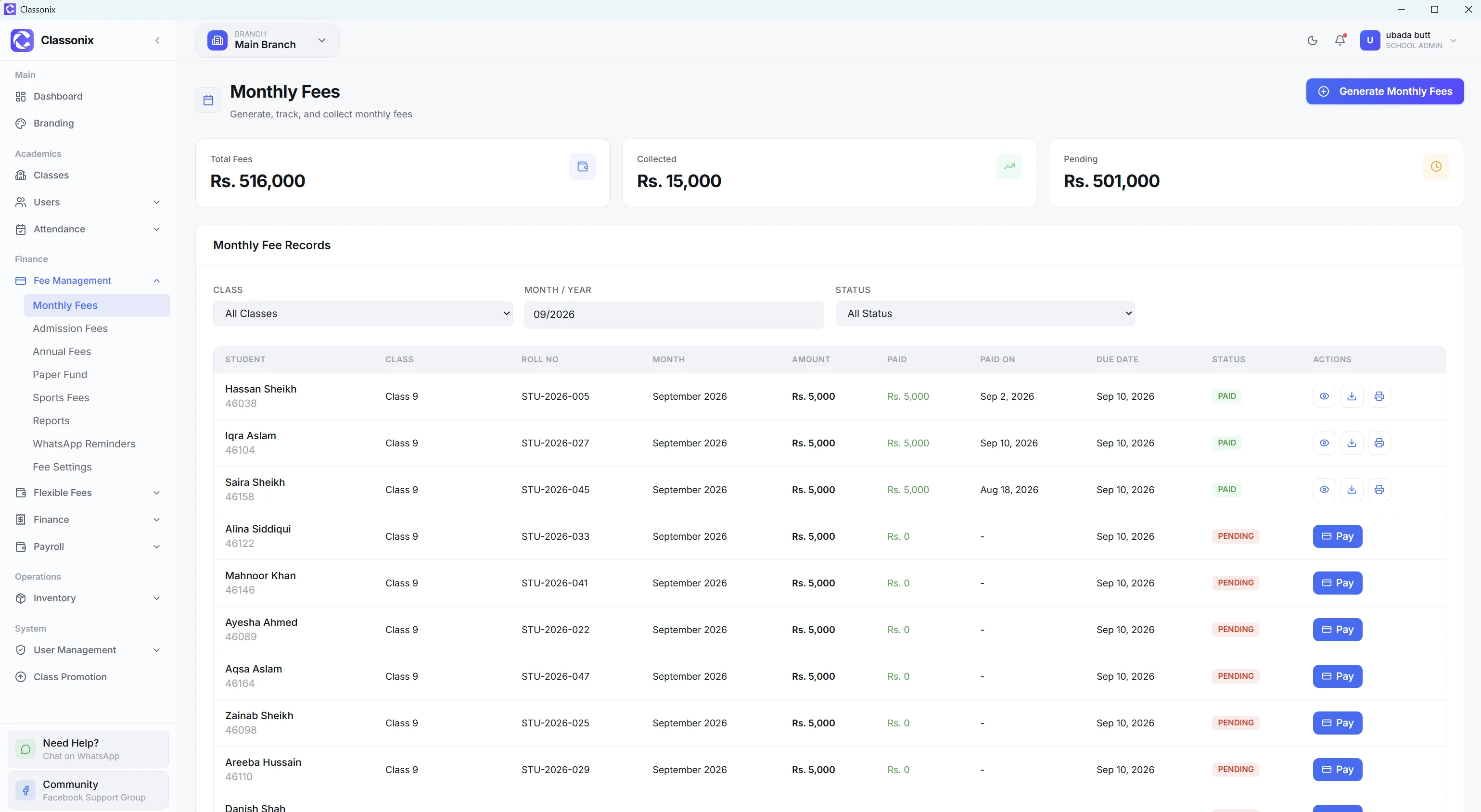
Manual fee collection becomes difficult when every month starts with the same sequence: prepare dues, distribute them, record payments, check partial balances and identify students who are still outstanding. A school fee collection system should make those steps visible and repeatable.
ClassoNix provides a structured fee workflow for generating monthly charges, recording payments and reviewing statuses. The product supports PENDING, PARTIAL, PAID and OVERDUE statuses, multiple partial payments and payment-history records. Schools can also use WhatsApp reminders with delivery tracking as part of the follow-up process.
Generate Fees for a Whole Class
The monthly-fee screen lets staff select a class and month/year and generate fees for all or selected students, with a due date. This is useful when a school wants a consistent monthly process instead of creating individual fee records one by one. Each generated voucher becomes a full fee record with its own status and due date, so generation and tracking happen in the same step.
Automatic monthly generation is also supported. A scheduled job generates fee records for active students on the school’s configured generation day each month, using their individual fee amount. Existing records for that month are skipped, helping prevent duplicate monthly charges — the run is idempotent by design, so re-running or overlapping months never double-charges a student.
Track Paid, Partial and Unpaid Fees
A collection workflow needs to distinguish different payment situations. ClassoNix provides four monthly-fee statuses: PENDING, PARTIAL, PAID and OVERDUE. Each fee record can store multiple partial payments, including amount, date, method and remarks, along with the full payment history.
That makes the collection list more useful than a simple yes/no register. Accounts staff can identify which students still have a balance and review the history behind the current status.
Keep a Clear Defaulter List
The fee system provides filters by class, status, month and year, along with statistics for total fees, collected and pending amounts. This gives staff a direct way to work through outstanding records.
ClassoNix does not promise a particular reduction in defaulters. Instead, it gives the school the records and communication tools needed to manage follow-up systematically — software can improve visibility and workflow, but collection outcomes still depend on the school’s own policies and parent responses — what the system guarantees is that no overdue record hides in a register page nobody checked.
Issue Receipts and Preserve Payment History
Payments can be recorded using cash, bank transfer, cheque, online or other methods. Amount, date and remarks are stored with the payment, and the fee record retains its payment history.
For schools, this creates a traceable record of how a balance was settled. It also makes partial-payment situations easier to understand when a parent pays across multiple dates.
Pakistan-Specific Fee Collection
ClassoNix supports PKR fee amounts and the fee categories schools commonly use, including monthly, admission, annual, paper-fund and sports fees. For schools using flexible or program-based fees — including custom installment plans — the separate Flexible Fees module is available when the relevant entitlement is enabled.
The product also connects fee follow-up with WhatsApp reminders, where message delivery can be tracked as SENT, DELIVERED, READ or FAILED.
Move Beyond the Spreadsheet
A spreadsheet can calculate balances, but a school still has to maintain the workflow around it. ClassoNix puts generation, payment records, status filters, fee reporting and reminders into dedicated screens.
The result is a fee-collection process that can be reviewed from the same system as the rest of the school operation — the accounts office, the front desk and management all read the same statuses instead of maintaining parallel lists — see how it fits into the wider fee management platform.
Related Features
See how the rest of the ClassoNix platform connects with this workflow.
Questions, Answered
How fee collection works inside ClassoNix.
ClassoNix’s monthly-fee workflow allows fee vouchers to be generated for all or selected students within a class. Automatic monthly generation can also create records for active students on the school’s configured generation day, while avoiding duplicate records for the same month.
The product includes monthly, admission, annual, paper-fund and sports fees. ClassoNix also has a separate Flexible Fees workflow for schools using flexible or program-based fee structures.
A fee record supports multiple partial payments, with each payment storing its amount, date, method and remarks. Schools on flexible-fee structures can also configure custom installment plans with an installment count and amount inside the Flexible Fees workflow.
Fee Settings includes configurable late-fee rules: a late-fee amount can be enabled, with an optional per-day accrual mode. Combined with due dates and the OVERDUE status, this gives the school a structured way to apply its own late-fee policy.
Yes. Fee records can be filtered by status, class, month and year, and the monthly-fee area provides total, collected and pending statistics. This helps accounts staff identify outstanding records without manually rebuilding the list.
Stop Rebuilding the Fee List Every Month
Generate, track and follow up on fees from one screen — starting with the free plan.
Free forever plan · No credit card required