
WhatsApp Fee Reminders for Schools
Send fee reminders parents actually read — with delivery tracking (sent, delivered, read, failed) and visible message quota.
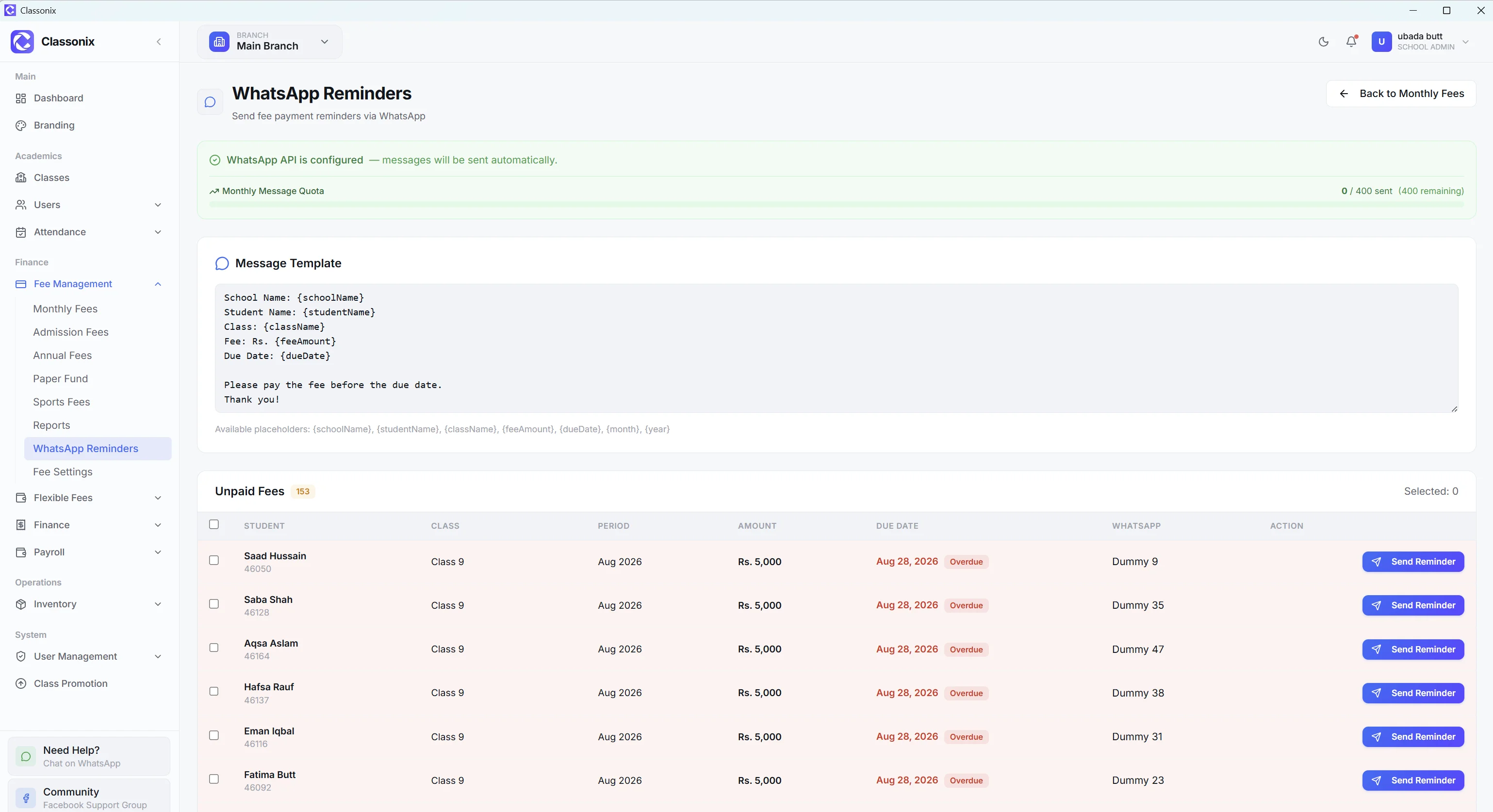
Parents already use WhatsApp for everyday communication, so schools often prefer it for timely reminders instead of relying only on paper notices, calls or traditional SMS. The important part is not merely sending a message. School management needs to know what was sent, what status it reached and how much messaging capacity remains.
ClassoNix includes WhatsApp fee reminders with delivery tracking. The product identifies SENT, DELIVERED, READ and FAILED states and exposes sent, limit and remaining quota information. The free plan includes 50 WhatsApp messages per month.
Why WhatsApp Fits School Communication in Pakistan
WhatsApp is a familiar communication channel for many families, which makes it useful for school reminders and notices. A structured school workflow can use it to communicate fee-related information without asking the accounts team to maintain a separate manual reminder list.
ClassoNix treats WhatsApp as part of the school-management workflow rather than as an isolated messaging tool. Fee reminders connect to the school’s collection process, while message status remains visible in the system.
Compared with printed circulars or phone calls, a WhatsApp reminder reaches a channel parents check daily, and the record of the attempt stays inside the school’s own system rather than in a staff member’s personal phone — important when staff change and the reminder history should not leave with them.
Send Reminders Straight From Unpaid Fee Records
The WhatsApp reminders screen lists pending and overdue fee records, lets staff select the relevant students, and sends reminders in one action — no separate contact list required. Students without a WhatsApp number on file are excluded automatically — the send list always reflects the parent contact data actually stored on the student record.
This makes the feature particularly relevant to schools with recurring monthly collections where the same communication pattern happens every month: review the unpaid list, select the records, send the reminders, and check the resulting delivery status.
Because the screen works from fee records rather than a typed-in list, a reminder can never be sent to a student whose balance was already settled — the unpaid list the staff see is the same list the accounts office sees.
Know Whether a Message Was Delivered or Read
ClassoNix tracks four WhatsApp delivery states: SENT, DELIVERED, READ and FAILED. These statuses provide a clearer communication trail than simply assuming that a reminder reached the parent.
The distinction is useful operationally. A school can separate a message that was successfully delivered from one that failed and can see when a message has reached the read state — giving management a realistic view of follow-up.
A FAILED status is information too: it usually points at a stale or non-WhatsApp number on the student record, which the school can then correct instead of silently resending to a dead number every month.
See Sent, Limit and Remaining Quota
Messaging costs and limits should not be hidden from the school. ClassoNix exposes sent, limit and remaining quota information. The current free plan includes 50 WhatsApp messages per month.
Plan tiers provide different monthly quotas — GROWTH lists 600 messages per month, PROFESSIONAL 1,500 and ELITE 2,500. Check current pricing for the latest plan details.
A Practical Collection Workflow
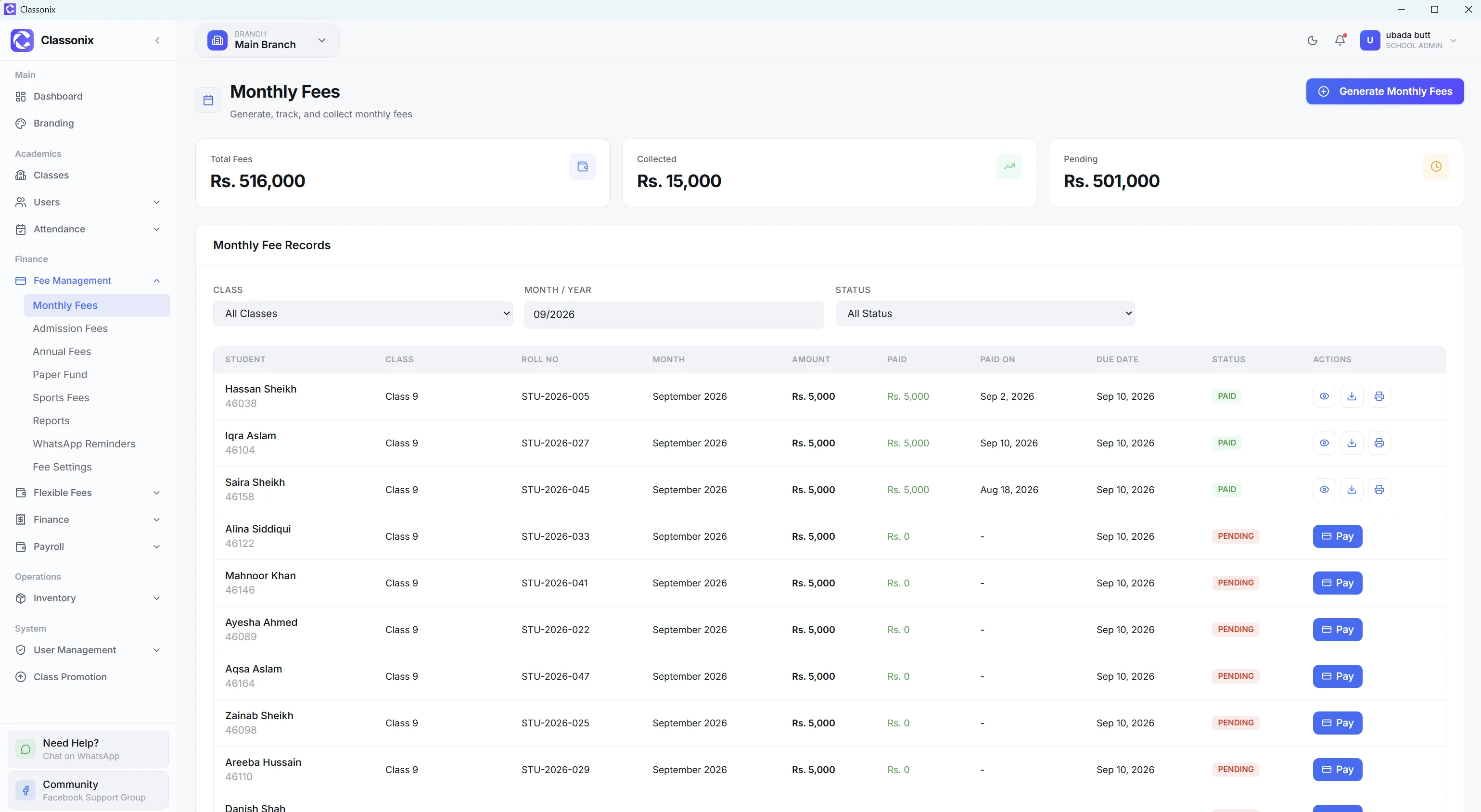
A strong reminder workflow begins with accurate fee records. ClassoNix’s fee module identifies PENDING, PARTIAL, PAID and OVERDUE statuses. WhatsApp reminders then provide a communication layer around those records.
That combination is more useful than a generic messaging service because the school can work from the same operational context: which student has a fee balance, which reminder was sent and what delivery state was returned. See the fee side on the fee collection page.
The workflow repeats monthly without rebuilding anything: generation creates the vouchers, due dates define who becomes overdue, and the reminders screen turns that overdue list into a tracked communication round.
Related Features
See how the rest of the ClassoNix platform connects with this workflow.
Questions, Answered
How WhatsApp reminders work in ClassoNix.
ClassoNix includes WhatsApp fee reminders as part of its school-management workflow. The reminders screen lists pending and overdue fee records so staff can select students and send reminders directly. The product tracks message delivery states including SENT, DELIVERED, READ and FAILED, while the fee module provides the payment status used for collection follow-up.
ClassoNix tracks a READ delivery status for WhatsApp messages. This allows the school to distinguish a message that reached the read state from one that is only sent or delivered. It should not be interpreted as proof that the parent acted on the message — a READ status confirms the message reached the read state, which is still far more useful than assuming a paper notice arrived home in a school bag.
The FREE plan includes 50 WhatsApp messages per month. GROWTH includes 250, PROFESSIONAL 400 and ELITE 600. Additional messages can be added anytime at Rs. 4 per message. See the pricing page for current limits.
Reminders are sent from the WhatsApp reminders screen, where staff select unpaid fee records and send them in a single action. Because reminders are tied to pending and overdue records, due dates in the fee records drive which students appear for follow-up.
Reach Parents Where They Already Are
Trackable WhatsApp reminders connected to real fee records — starting with 50 free messages a month.
Free forever plan · No credit card required