
School Finance & Accounting
Income, expenses, profit & loss and a central transaction log — know your school’s financial position without combining spreadsheets.
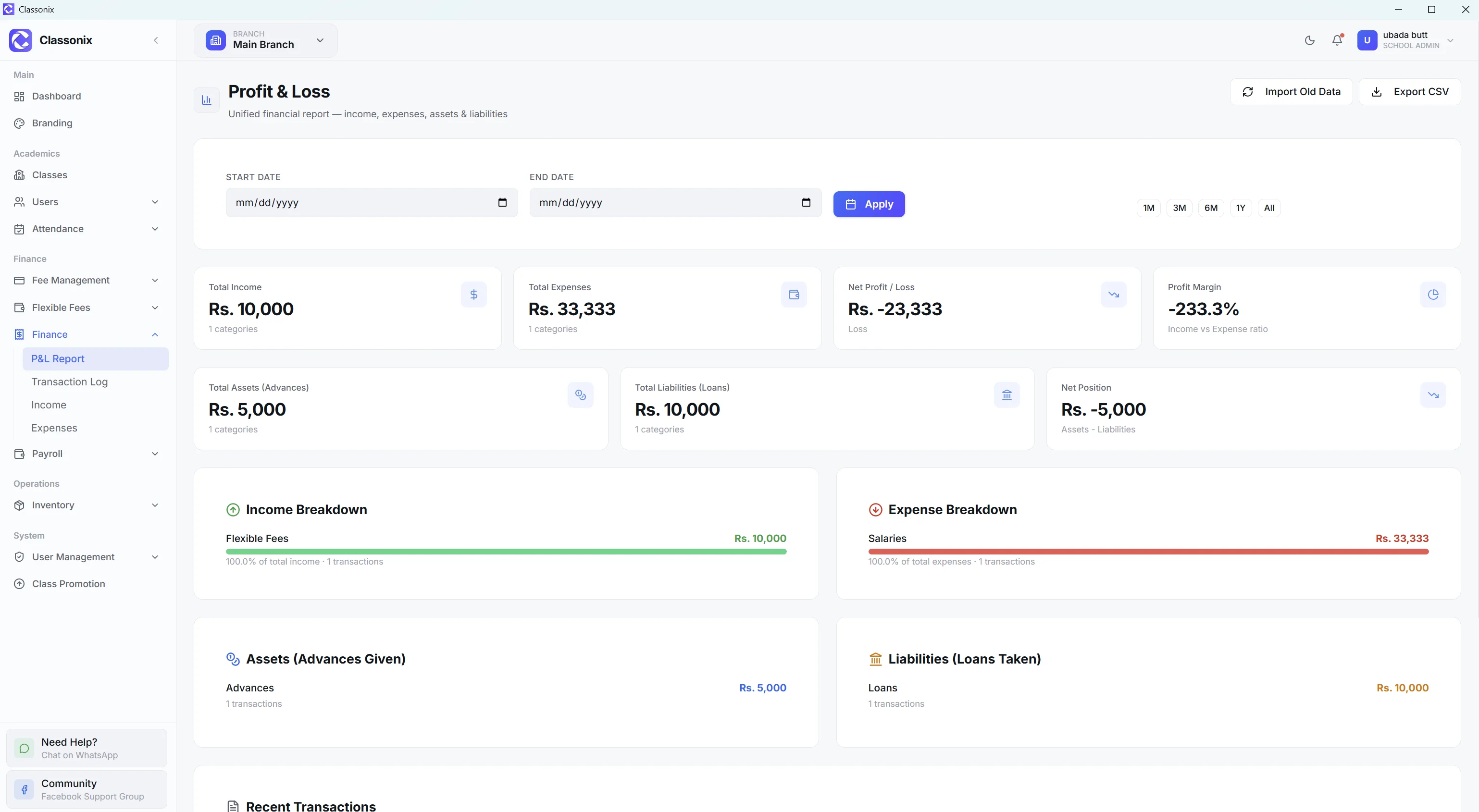
A school can collect fees successfully and still lack a clear picture of its overall finances. Income, expenses, payroll and transactions need to be understood together — fee income means little on its own if the expense side is a mystery if management wants to know whether the institution is operating within its financial plan.
ClassoNix includes dedicated finance workflows for income, expenses, profit and loss and transaction logging. The dashboard provides financial KPIs and can compare income and expenses over time when the underlying data is available — a month-by-month picture forms automatically as records accumulate, without anyone maintaining a summary sheet. Payroll is also part of the broader financial picture.
In a register-based office these figures exist in different places: the fee book, the expense notebook, the payroll sheet and someone’s mental arithmetic. An operational finance module puts them in one consistent view.
One Place for School Income and Expenses
The finance area separates income and expenses into dedicated workflows while also maintaining a transaction log. This creates a structured record for the money moving through the school.
Expense management is particularly useful when spending needs to be categorized rather than kept as a single monthly number — the Expenses module provides a dedicated area for recording and reviewing school spending.
Expense categories can be configured — including custom categories — so a school can classify spending the way it actually operates rather than forcing every cost into a generic ‘other’ bucket.
Profit and Loss for School Management
ClassoNix includes a P&L report for plans where finance is available, with a CSV export option for the report. The dashboard also provides a net figure when it can be reliably computed and a grouped comparison of income versus expenses for the last six months.
The product deliberately avoids fabricating comparison data when a previous period is unavailable. That behavior matters for financial reporting: the interface shows comparisons only when the underlying data exists.
That restraint matters for a small school’s accounts: a trend line or net figure is only useful if it is computed from real records, which is why the report favors honest numbers over complete-looking charts — a decision made on a fabricated trend is worse than one made on a partial truth.
Fee Income and Payroll in the Financial Picture
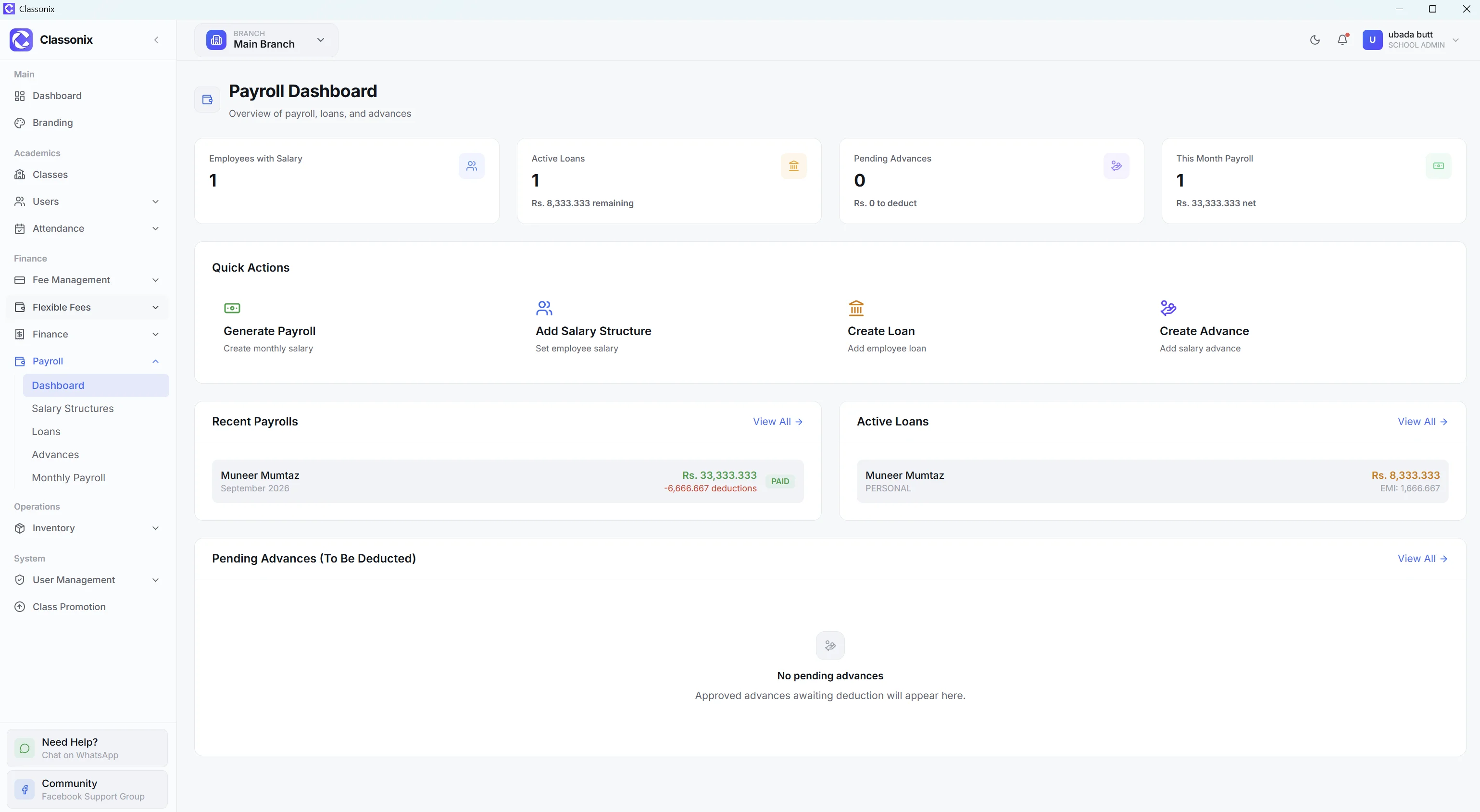
Fee collection is one of the school’s main operating flows, while payroll is a major expense area. ClassoNix connects both to the financial view — payroll is treated as an expense line connected to P&L, while fee records provide the income side of daily operations.
The transaction log provides a central record of financial activity. This is useful when management needs to move from a high-level P&L view to the underlying transactions — the same log that fee payments, expenses and payroll activity write into.
Unified Transaction Visibility
The transaction log provides a central record of financial activity. This is useful when management needs to move from a high-level P&L view to the underlying transactions.
The goal is not to replace every accounting system used by every organization. It is to give school management a structured operational finance layer connected to the school’s fees and payroll workflows — one where ‘what came in’, ‘what went out’ and ‘what is left’ are questions the system answers, not a spreadsheet someone maintains at month end.
Pakistan-Specific School Finance
ClassoNix is designed for school operations where fees are recorded in PKR and multiple fee categories may be used. The finance workflows connect naturally to fee collection and payroll inside the same platform, so the two biggest money flows in a school — what parents pay and what staff are paid — meet in the same accounts view.
The module focuses on operational finance — it is an operational record for the school office, not a statutory accounting or tax-filing system.
For a multi-branch school the same finance workflows stay branch-scoped, so each campus’s income and expense records follow its own books rather than being pooled into the group’s.
Related Features
See how the rest of the ClassoNix platform connects with this workflow.
Questions, Answered
How ClassoNix handles school finance and accounting.
ClassoNix includes a Profit & Loss report and dashboard financial KPIs. The exact freshness of each view depends on the current data and caching behavior — treat the report as the school’s financial view rather than a promise of a specific refresh interval.
Yes. The Expenses module supports user-defined categories — expenses can be recorded and filtered by category, with a category breakdown in the expense summary.
Fee records provide the income side of school operations and payroll is treated as an expense line connected to the P&L view. The finance module itself tracks income, expenses, transactions and profit and loss in one place.
Yes. The Profit & Loss report provides a CSV export. The transaction log and income/expense screens provide their own structured views for review.
Know Your School’s Financial Position
Income, expenses, payroll and P&L — one finance layer connected to the rest of the school.
Free forever plan · No credit card required