
Fee Management Software for Schools in Pakistan
Fee generation, payment recording, status tracking, reports and WhatsApp reminders — one fee workflow instead of separate registers.
Fee collection is one of the most repetitive administrative responsibilities in a school. A typical month can involve generating dues, checking who has paid, recording partial payments, identifying overdue accounts, issuing receipts and following up with parents. When those steps depend on separate registers or spreadsheets, the finance team spends time maintaining records instead of reviewing the school’s actual collection position — and month-end figures still arrive late.
ClassoNix brings fee generation, payment recording, status tracking, reports and WhatsApp communication into one fee-management workflow. It covers monthly, admission, annual, paper-fund and sports fees, as well as partial payments and multiple payment methods. For schools using a flexible fee model, ClassoNix also provides a separate flexible-fee workflow.
The result is a fee office that works from records rather than memory. Because fee data lives inside the same platform as student profiles, attendance and finance, the accounts team does not need to reconcile a fee register against a separate student list before answering a simple question about who has paid.
The Fee Collection Problem in Pakistani Schools
School fee structures are rarely limited to one simple recurring charge. A school may collect monthly tuition alongside admission charges, annual charges, paper funds or sports-related fees. Different students can also have different payment situations, including partial payment and overdue balances.
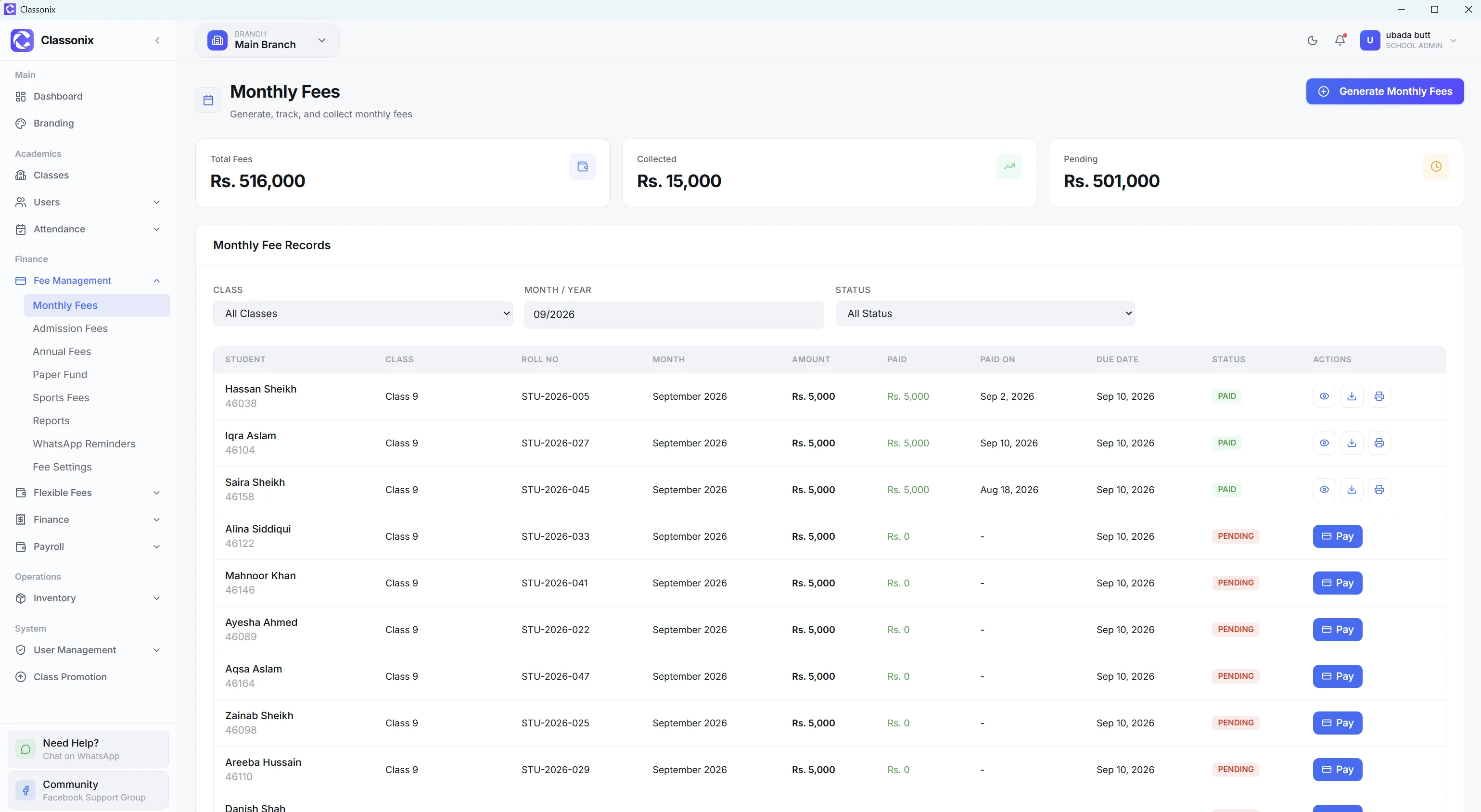
A useful fee-management system therefore needs more than a list of paid invoices. It needs generation, status visibility, payment history and reporting. ClassoNix’s monthly-fee workflow allows a class and month/year to be selected, fees to be generated for all or selected students, and a due date to be set. Records can then be filtered by class, status, month and year.
For parents, the difference shows up at collection time: a school that can see pending and partial records accurately can communicate about dues clearly instead of sending generic reminders to every family — including ones who already paid.
In many Pakistani schools the fee register is also the de-facto ledger for every other charge a student can incur. When monthly tuition, admission charges and event fees are kept in separate books — or worse, separate people’s memories — the month-end picture takes days to assemble and is still approximate.
How ClassoNix Fee Management Works
The monthly-fee workflow is designed around the complete collection cycle. A school can generate fees for a class or selected students, set the due date, and then record payments against each fee record.
Each monthly fee record can have a status of PENDING, PARTIAL, PAID or OVERDUE. Multiple partial payments can be recorded, with payment method, amount, date and remarks stored in the record. This means a student does not need to be treated as simply ‘paid’ or ‘unpaid’ when the actual situation is a partial collection.
The product also supports automatic monthly fee generation. A scheduled job generates records for active students on the school’s configured generation day each month, using their individual fee amount, while avoiding duplicate records for a month. This is configured through Fee Settings — including optional late-fee rules with a fixed amount or per-day accrual.
Waived and manual entries are handled the same way as generated ones: every fee is a record with a status, a due date and a payment history, so unusual situations do not force staff outside the system. Receipt issuance follows the same records: once a payment is logged, the collected amount, remaining balance and payment method are all visible without assembling them from a receipt book.
Every Fee Type Your School Charges
ClassoNix provides several fee workflows instead of forcing every charge into one generic monthly record. Schools should configure the fee model around how they actually charge students — not force every institution into the same recurring monthly structure.
Each fee type keeps its own records while sharing the same payment machinery — statuses, partial payments, payment history and WhatsApp reminders all work identically whether the charge is monthly tuition or a one-time sports fee.
Monthly Fees
Recurring charges generated by month and academic workflow, with due dates and status tracking.
Admission Fees
One-time enrollment fees assigned to selected new students and tracked through the same payment system.
Annual Fees
Charges that cover the academic year, managed as a dedicated fee type.
Paper Fund Fees
Fees covering exam papers and stationery.
Sports Fees
Charges for sports events and equipment.
Flexible Fees
A separate workflow for program or diploma-style fee structures, including custom installment plans with an installment count and amount.
Installments & Partial Payments
Real-world collections do not always arrive as one payment on one date. ClassoNix supports multiple partial payments on a fee record, with the payment amount, date, method and remarks recorded as part of the payment history. Payment methods include cash, bank transfer, cheque, online and other options.
Schools using flexible or program-based fee structures can also configure custom installment plans — an installment count and amount per plan — inside the separate Flexible Fees workflow.
The practical result is a more useful collection record: management can see the original fee status, the amount paid, what remains and the payment history rather than keeping a separate handwritten note for each installment.
Payment history stays attached to the student, so the same record answers questions at the counter, in the accounts office and in a management review — the parent who disputes a payment can be shown dates, amounts and methods rather than a scribbled register line.
For school groups, the same workflow applies per branch: fee records are scoped to the selected campus, and staff only see the branches assigned to them — collection discipline scales without mixing campuses.
See Exactly Who Has Paid — And Who Hasn’t
Fee records can be filtered by class, status, month and year, and the fee module provides summary statistics such as total fees, collected and pending amounts. The fee statuses make it possible to distinguish a completely unpaid fee from one that is partially settled.
That visibility is useful for both daily collection work and management review. Instead of asking the accounts team to calculate a list from separate files, management can work from the fee records and reports already maintained in the system.
Because the same records feed the wider finance view, fee income does not have to be re-entered when the school reviews its overall income and expense position.
WhatsApp Reminders With Delivery Tracking
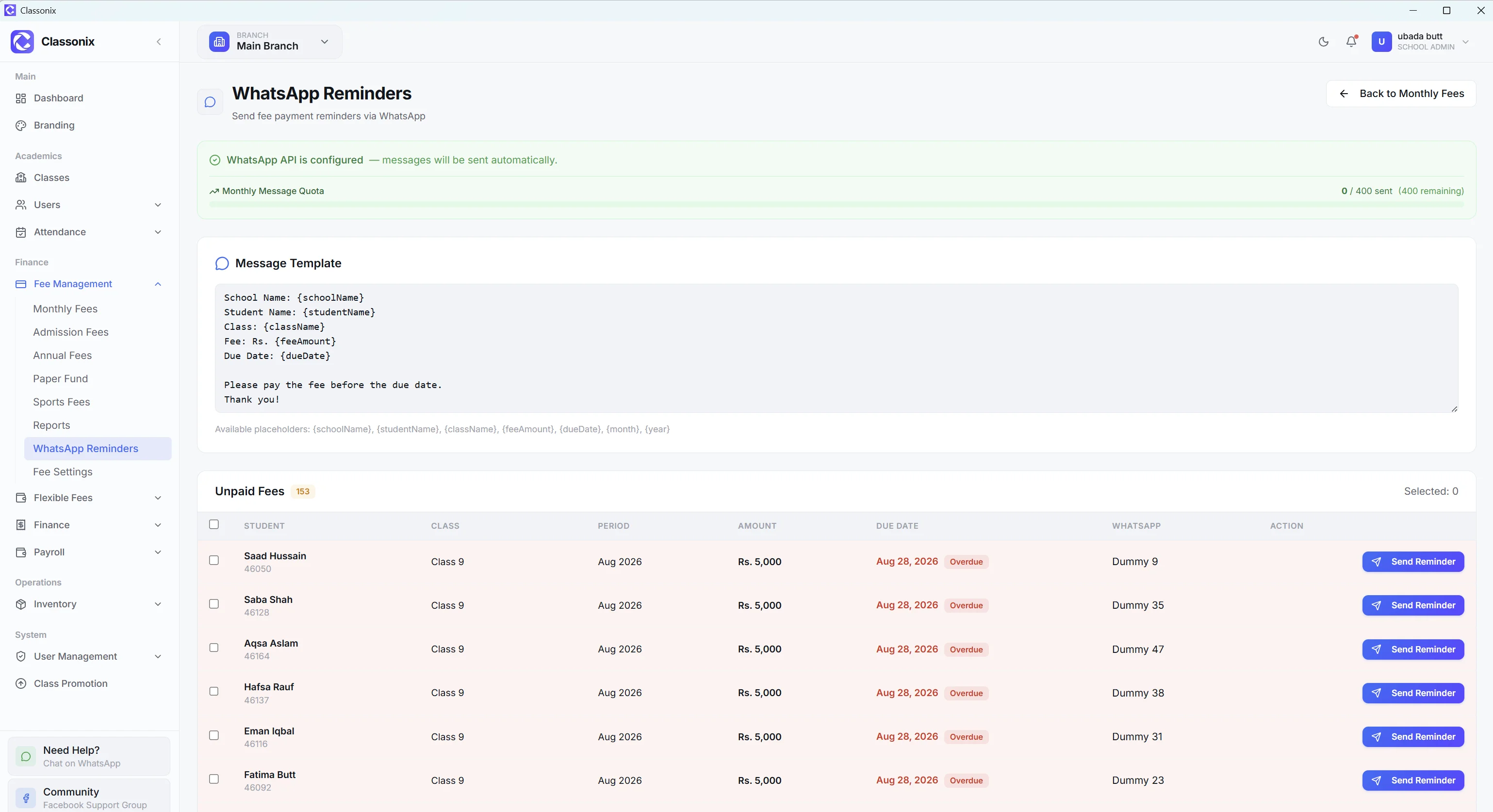
ClassoNix connects fee management with WhatsApp reminders. Delivery states include SENT, DELIVERED, READ and FAILED, while the interface shows sent, limit and remaining quota information. The free plan includes 50 WhatsApp messages per month.
This gives the school a clearer communication trail than a manual call list. A reminder can be part of the fee follow-up process while management can still see the message status and available quota. Learn more on the WhatsApp fee reminders page.
Reminder sending respects the plan’s monthly WhatsApp quota, which the interface displays as sent, limit and remaining counts — so staff always know how much of the month’s allowance is still available before sending a batch.
Who Is ClassoNix Fee Management For?
The fee module is designed for schools that need a structured way to generate and track student charges, record collections and review outstanding balances. It can support schools with recurring monthly fees as well as institutions that use additional fee categories.
It is especially useful when the accounts team needs a single source for fee status and payment history. Schools using a flexible program-based model can use the separate Flexible Fees workflow where that entitlement is enabled.
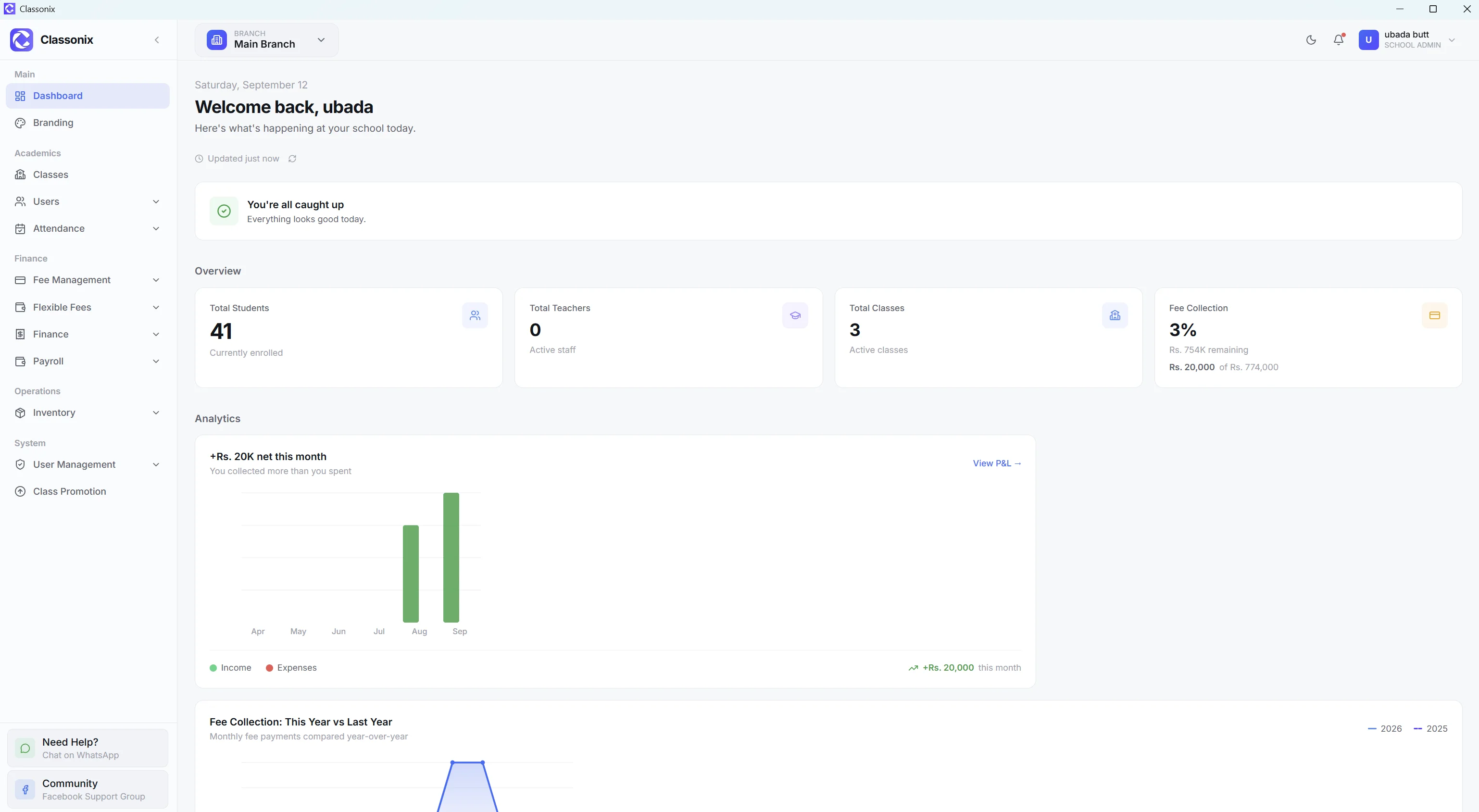
Fees are also part of the broader platform described on the school management system overview — the same records connect to attendance, finance and payroll rather than sitting in a standalone billing tool.
Related Features
See how the rest of the ClassoNix platform connects with this workflow.
Questions, Answered
Answers about fee generation, payments and reminders in ClassoNix.
Fee management software organizes the cycle from generating a charge to recording payment and reviewing outstanding amounts. ClassoNix provides fee-generation screens for monthly, admission, annual, paper-fund and sports fees, plus a separate Flexible Fees workflow for program-based structures. Each record carries a status and due date; payments are recorded with method, date and remarks; and reporting shows totals, collected and pending amounts, while WhatsApp reminders handle parent follow-up.
Yes. The monthly-fee workflow generates fee vouchers for all or selected students by class and month/year, each with a due date. Automatic monthly generation can also create vouchers for active students on the school’s configured generation day, while avoiding duplicates for the same month. Each voucher is a full fee record with status and due date, so generation and tracking happen in one step rather than two.
Monthly fee records support multiple partial payments with full payment history. Schools using flexible or program-based fees can configure custom installment plans (installment count and amount) inside the Flexible Fees workflow, and Fee Settings includes late-fee rules with a configurable amount and optional per-day accrual, so the school’s own policy is applied consistently instead of being negotiated case by case.
ClassoNix includes WhatsApp fee reminders with delivery tracking. Reminders are sent by staff from the reminders screen against pending or overdue fee records, and each message carries a delivery status — SENT, DELIVERED, READ or FAILED. The interface also shows the plan’s monthly quota as sent, limit and remaining counts, so a batch can never exceed the allowance unexpectedly.
It gives the school clearer visibility into pending, partial, paid and overdue fee records and supports WhatsApp reminder workflows. It does not guarantee a particular reduction in defaulters; schools use the visibility and communication tools to manage follow-up more consistently — status filters identify who is outstanding, and reminders reach parents on the channel they actually read.
Make Fee Collection Predictable
Generate fees, track statuses and send reminders — all inside the same system as the rest of your school.
Free forever plan · No credit card required